

Table of Contents
- How Fantasy Literature Gives Parents a Language for Hard Feelings
- The Therapeutic Benefits of Reading Fantasy After the Kids Are Asleep
- Building Empathy and Emotional Intelligence Through Fictional Characters
- Choosing Age-Appropriate Fantasy: A Practical Guide for Parents
- Fantasy as a Bridge: Starting Difficult Conversations Through Story
- Books for Neurodivergent Families: Finding Stories That See Your Child
- Conclusion: Why the Right Story Is Worth Making Room For
- Frequently Asked Questions
Last Updated: October 1, 2026
How Fantasy Literature Gives Parents a Language for Hard Feelings
Is fantasy literature helpful for parents? Yes, and often in ways that parenting manuals cannot match. Fantasy literature gives families a shared vocabulary for emotions that are hard to name out loud, especially when a child processes the world differently. This guide from CJ Gryffin explores why stories matter and how to choose them well.
A common mistake is treating fantasy as pure entertainment. In practice, it works more like a rehearsal space. A child meets a character who feels afraid, lonely, or misunderstood, and the story shows what that feeling looks like from the outside. American Psychological Association resources on children's emotional development notes that children build emotional understanding partly through narrative. For parents, that means a bedtime chapter can do quiet work that a direct conversation cannot.
The Therapeutic Benefits of Reading Fantasy After the Kids Are Asleep
The therapeutic benefits of reading fantasy extend well beyond the child. Parents who read after bedtime often describe the same relief: the day's tension loosens, and the mind finally settles. But the reason it works is more specific than "it's relaxing," and understanding the mechanism helps parents use it deliberately.
Researchers who study narrative transportation describe a shift in attention: when a reader is absorbed in a story, the mind stops rehearsing the day's unresolved moments. That is not escapism in the dismissive sense. Escapist literature offers a controlled distance from real worries. A parent can follow a character through loss or exhaustion, feel it fully, and then close the book. The emotion gets processed without being aimed at anyone in the house.
Three mechanisms do most of the work:
- Borrowed perspective. A parent reads a character's exhaustion from the inside and recognizes their own without having to defend it. The recognition arrives without a confrontation.
- Safe rehearsal. A difficult scene lets a parent feel the shape of a hard feeling, grief, resentment, fear for a child, in a container that closes when the chapter ends.
- Restored agency. Fiction usually gives characters a choice. A parent who feels stuck in a diagnosis, a school meeting, or a repeating argument gets a reminder that choices exist, even if the fictional ones look nothing like theirs.
A common pattern among parents of nonverbal children is that a clinical memoir feels like homework. A story about a nonverbal boy who is misunderstood, and who turns out to be destined for something larger, offers the same recognition without the clinical framing. The Color of Silence follows exactly that arc: Darius, five years old and labeled broken, finds a dragon named Azure who does not demand words. Sadie, his mother, carries the specific exhaustion of a parent who has been told by strangers that something is wrong, a feeling many readers recognize before they can name it.

The practical takeaway is timing. The same chapter read at 2 p.m. during a hard afternoon can feel like salt in a wound; read at 9 p.m. after the house is quiet, it does its work. The distance is the point.
One caution: if a parent notices that reading is the only thing that settles them, and the settling does not last, that is worth mentioning to a doctor or therapist. Fiction is a tool, not a substitute for care.
Building Empathy and Emotional Intelligence Through Fictional Characters
Empathy building through fictional characters is one of the most studied ideas in childhood literacy, and the mechanism is simple. Readers practice taking another person's perspective, then carry that habit into real relationships.
Fictional archetypes help here. A dragon who speaks in riddles, a neighbor who misreads a child's silence, a mother who is exhausted and still trying: these figures let a child test moral dilemmas without real consequences. What would you do if someone called your friend broken? The story asks the question safely.
For neurodivergent families, this matters twice over. Readers with autism and their siblings often encounter few characters who think the way they do. A large share of young readers receive special education services, according to the National Center for Education Statistics, yet rarely see themselves in a leading role. Stories that cast a nonverbal protagonist as the hero correct that gap quietly.
Choosing Age-Appropriate Fantasy: A Practical Guide for Parents
Age-appropriate fantasy selection comes down to three questions: can my child follow the plot, can my child handle the fear, and does my child see anyone like themselves in it?
Most guides skip the third question. That is the gap worth closing.
Use this checklist before buying or borrowing:
- Does the main character face a problem my child recognizes?
- Is the scary content resolvable within the story, not left hanging?
- Are there characters who are nonverbal, disabled, or otherwise outside the usual mold?
- Can my child retell the plot in their own way, whether through words, drawing, or gesture?
- Will I enjoy reading it aloud for the fifth time?
Reader Need |
What to Look For |
Why It Matters |
|---|---|---|
Sensitive to loud conflict |
Quiet, atmospheric pacing |
Reduces bedtime distress |
Learns visually |
Strong color and imagery |
Supports comprehension |
Nonverbal or minimally verbal |
Protagonists who communicate differently |
Builds identification |
Reluctant reader |
Short chapters, clear stakes |
Keeps momentum |
Advanced reader, young age |
Thematic depth over graphic content |
Matches skill without overshooting |
Fantasy as a Bridge: Starting Difficult Conversations Through Story
Fantasy as a bridge works because it moves the hard conversation into the third person. Instead of asking a child why they cried at school, a parent can ask what the character in chapter four should have done.
Books for Neurodivergent Families: Finding Stories That See Your Child
Books for neurodivergent families should do one thing above all: treat a different way of experiencing the world as a way of experiencing the world, not a defect to be corrected. Most ranking articles on fantasy and parenting never address this at all, which is why it is worth slowing down here.
- Communication variety. Does at least one character communicate without standard speech, through gesture, drawing, music, or pattern? A nonverbal protagonist is rare; when one appears, it changes what a nonverbal child believes is possible for a hero.
- Sensory load. Are the scary or intense scenes short and resolvable, or do they pile up? Readers with sensory processing differences often need the tension to close within a chapter, not across three.
- Predictable structure. Clear chapter shapes and returning rituals (a nightly ritual, a repeated phrase, a map at the front) lower the cognitive cost of following the plot.
- No cure narrative. The character's difference should not be resolved by becoming typical. A story that ends with the child "fixed" teaches the wrong lesson, however warm its intentions.
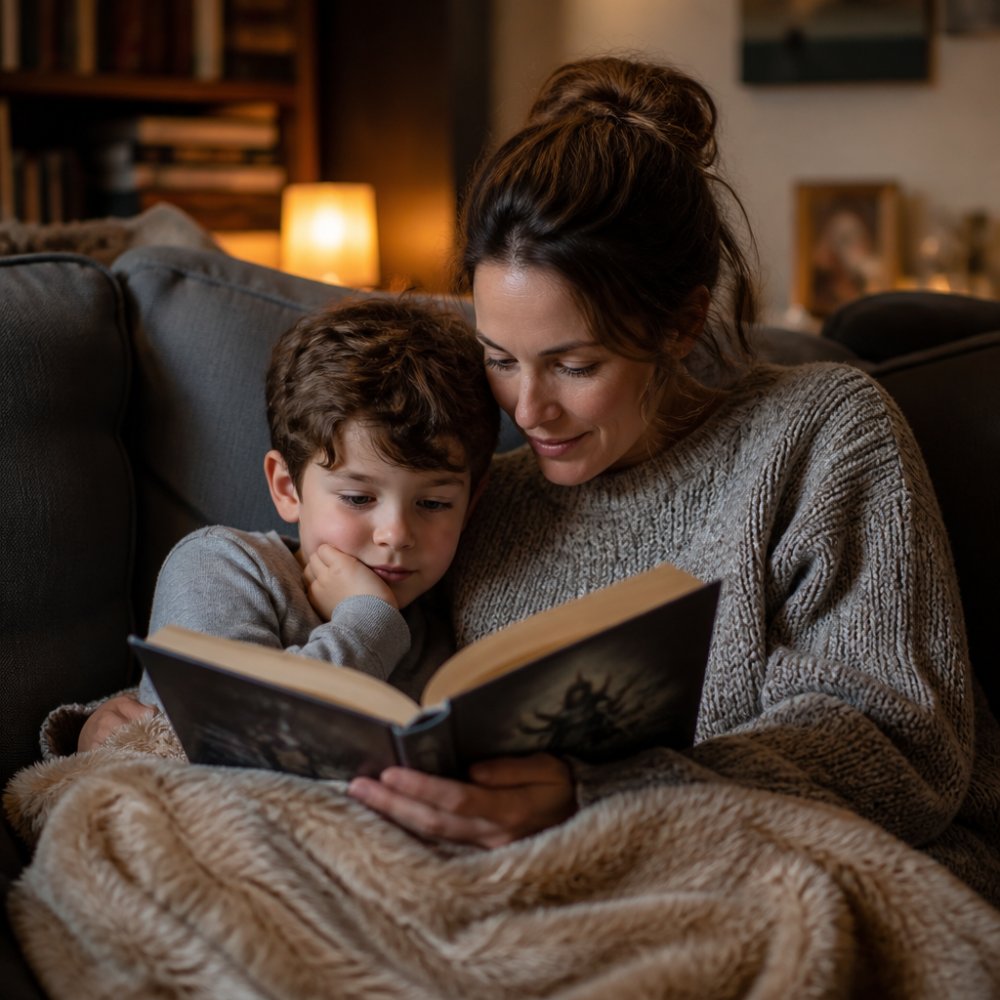
Let the child choose the book, even if it is the same one for two weeks. Repetition is how the story becomes theirs.
Conclusion: Why the Right Story Is Worth Making Room For
Finding a book that fits a family's actual life takes some searching, and the search is worth it. The right story gives parents language for hard feelings, gives children a character to recognize themselves in, and gives everyone a reason to sit in the same room at the end of the day.
Frequently Asked Questions
Are there real benefits to reading fantasy books as a parent?
Yes. Fantasy literature gives parents a low-stakes way to process stress, grief, and exhaustion without reliving their own situation page by page. The distance of a fictional world makes hard emotions easier to approach, and that distance often makes the feelings more manageable, not less. Many parents also find that finishing a chapter restores the patience and perspective they need for the next morning. It is not a replacement for support, but it is a genuinely useful habit.
Can fantasy literature improve empathy in parenting?
Reading fiction asks you to follow someone else's choices from the inside, which is the same muscle empathy uses. For parents, that practice pays off in small moments: pausing before reacting, asking what a behavior might mean instead of what it looks like. Books with complex relationships and moral dilemmas push this further because there is no easy answer to copy. The effect builds over time and across many stories, not from a single novel.
How do I choose age-appropriate fantasy for my child?
Start with your child's sensitivity, not their reading level. A strong reader may still be unsettled by loss, danger, or betrayal in a story. Read the first chapter yourself, check whether the scary parts resolve, and look for characters your child can recognize themselves in. Then read it together the first time so you can pause and talk. Age-appropriate means emotionally appropriate for your specific kid, not a number on a spine.
What should I look for in books for neurodivergent families?
Look for stories where a neurodivergent or nonverbal character is the hero rather than the problem to be solved. The best ones show inner life, not just outward behavior, and let the character change the world instead of being fixed by it. The Color of Silence by CJ Gryffin is one example: a nonverbal five-year-old in 1930s Atlanta who finds a dream realm where words are not the only way to be heard. That kind of representation can help the whole family feel less alone.