

Table of Contents
- How Music Enhances Reading Experience: The Basics
- The Benefits of Background Music for Reading
- When Lyrics Get in the Way: Cognitive Load and Comprehension
- Finding Your Volume: The Goldilocks Level for Deep Reading
- Music and Neurodivergent Readers: Focus, Regulation, and Comfort
- Books About Nonverbal Autistic Children and the Role of Sound
- Companion Soundtracks: A Different Way to Read
- Frequently Asked Questions
Last Updated: September 27, 2026
How Music Enhances Reading Experience: The Basics
Music enhances reading when it lowers mental noise instead of adding to it. The effect is real, but it is not automatic. Producer of Window Light Studio, Andy Thompson, who is a song writer and father of a son with autism built a companion soundtrack for a novel precisely because sound can change how a story lands.

Reading is not one task. It is several at once: decoding words, holding meaning, tracking a plot, and managing mood. Music can help or hurt each of those.
What Happens in the Brain When You Read With Music
Reading with music splits your attention between two streams of sound and text. The brain handles both in working memory, the short-term system that holds what you are processing right now.
When the music is predictable, it fades into the background. When it competes with language, it does not. This is why instrumental music usually works better than songs with words.
Why the Effect Depends on the Reader
There is no single answer to whether music helps reading. It depends on the person, the book, and the moment.
- Task difficulty: Easy reading tolerates more sound. Dense text needs quiet.
- Familiarity: A song you know by heart pulls attention away.
- Mood: Music that calms you helps. Music that amps you up can break focus.
- Age: Children and adults respond differently, which we cover later.
What most guides miss is that the reader is the variable, not the music.
The Benefits of Background Music for Reading
Background music helps reading by steadying mood, blocking outside noise, and extending how long a reader can stay with a book. Those three effects matter more than any boost to raw comprehension.
Think of music as a mood tool first. A reader who feels calm reads longer than one who feels restless.
Focus, Mood, and Stamina
A common mistake is treating music as a focus hack. In practice, it is usually a mood tool that indirectly supports focus.
- It masks distracting sounds like traffic or conversation.
- It sets a consistent emotional tone for a reading session.
- It makes long stretches of reading feel less tiring.
- It can signal to your brain that reading time has started.
What Instrumental Music Does Differently
Instrumental music avoids the biggest problem with music and reading: words. A song with lyrics gives your brain a second language stream to process.
Instrumental tracks, ambient pieces, and film scores leave the language centers free. That is the whole point.
The trade-off is real. Instrumental music still competes for some attention, so it works best for lighter reading and familiar material. For a first pass through something difficult, silence still wins.
When Lyrics Get in the Way: Cognitive Load and Comprehension
Lyrics hurt reading comprehension because they compete with the text for the same mental resources. Your brain processes both through language, and it cannot fully do two language tasks at once.
This is called cognitive load, and it is the single best predictor of whether music will help or hurt.
A few practical rules follow from that:
- Skip lyrics for dense nonfiction, textbooks, or anything you need to retain.
- Lyrics are fine for light fiction, skimming, or rereading something you know.
- If you notice yourself rereading the same line, the music is the problem.
- Switch to instrumental or silence before you blame your own focus.
The American Psychological Association's overview of music and cognition notes that background sound affects attention differently depending on the task and the listener, which is why blanket advice rarely holds.
Finding Your Volume: The Goldilocks Level for Deep Reading
The best volume for reading is the lowest level that still masks background noise, usually just below normal conversation. Loud enough to cover the room, quiet enough to forget.
Most readers set music too loud. They pick a comfortable listening volume, not a comfortable reading volume. Those are different numbers.
Try this before your next session:
- Set the track at a level that feels slightly too quiet.
- Read one page. If outside sounds break through, nudge it up one step.
- Read another page. If you catch yourself tracking the melody, nudge it down.
- Lock that level and reuse it.
The goal is a distraction threshold you can stay under. Once music becomes something you notice, it has stopped helping.
Headphones change the math. Over-ear headphones with passive noise blocking let you play music quieter than you would through a speaker. That is usually the better setup for deep reading.
Music and Neurodivergent Readers: Focus, Regulation, and Comfort
For many neurodivergent readers, sound is not a preference. It is a regulation tool. The right auditory environment can make reading possible where silence cannot.
This is where the research gets interesting, and where generic advice fails.
Some readers need a steady sound floor to concentrate. Total silence makes every small noise feel enormous. A consistent, predictable track covers those spikes and lets attention settle.
Others need the opposite: a quiet room, no input, and a closed door.
In practice, this means the same advice does not fit every reader:
- Sound-sensitive readers often do better with low, steady instrumental tracks or white noise.
- Readers who seek input may focus better with rhythmic music at a moderate volume.
- Readers who struggle with transitions can use a playlist as a start and stop cue.
- Readers with attention differences often benefit from the mood regulation music provides.
The CDC's page on autism and related developmental information covers how sensory processing varies widely from person to person, which is exactly why a single rule about music and reading does not work.
What matters is that the reader gets to choose. Being told to sit in silence when silence is the problem is not a neutral instruction.
Books About Nonverbal Autistic Children and the Role of Sound
Books about nonverbal autistic children give readers a way into an experience that words often fail to capture. Sound can deepen that connection, especially when a story centers on a character who does not speak.
Darius Turner, the five-year-old at the center of The Color of Silence, is nonverbal. The novel is set in 1930s Atlanta and follows Darius, his mother Sadie, and a dragon named Azure who meets him in a dream realm called Somnoria.

Darius is written as neurodivergent, not labeled with a diagnosis. That choice matters. It keeps the story about who he is rather than what a chart says about him.
For families, stories like this do something a parenting book cannot. They let a reader feel the emotional shape of a life rather than read instructions about it.
One reader, a mother of a nonverbal child, put it this way:
"As a mom to a nonverbal child, I felt every emotion Sadie carries. The exhaustion, the wonder, the magic. This story felt like it was written for me."
Another reader said the book "gave words to emotions I've carried for years."
That is the point of pairing sound with a story like this. Music reaches feeling directly, without needing language as a middle step.
Companion Soundtracks: A Different Way to Read
A companion soundtrack is music written to sit alongside a specific book, timed to its emotional arc rather than chosen at random. It turns background music from a focus tool into part of the reading experience itself.
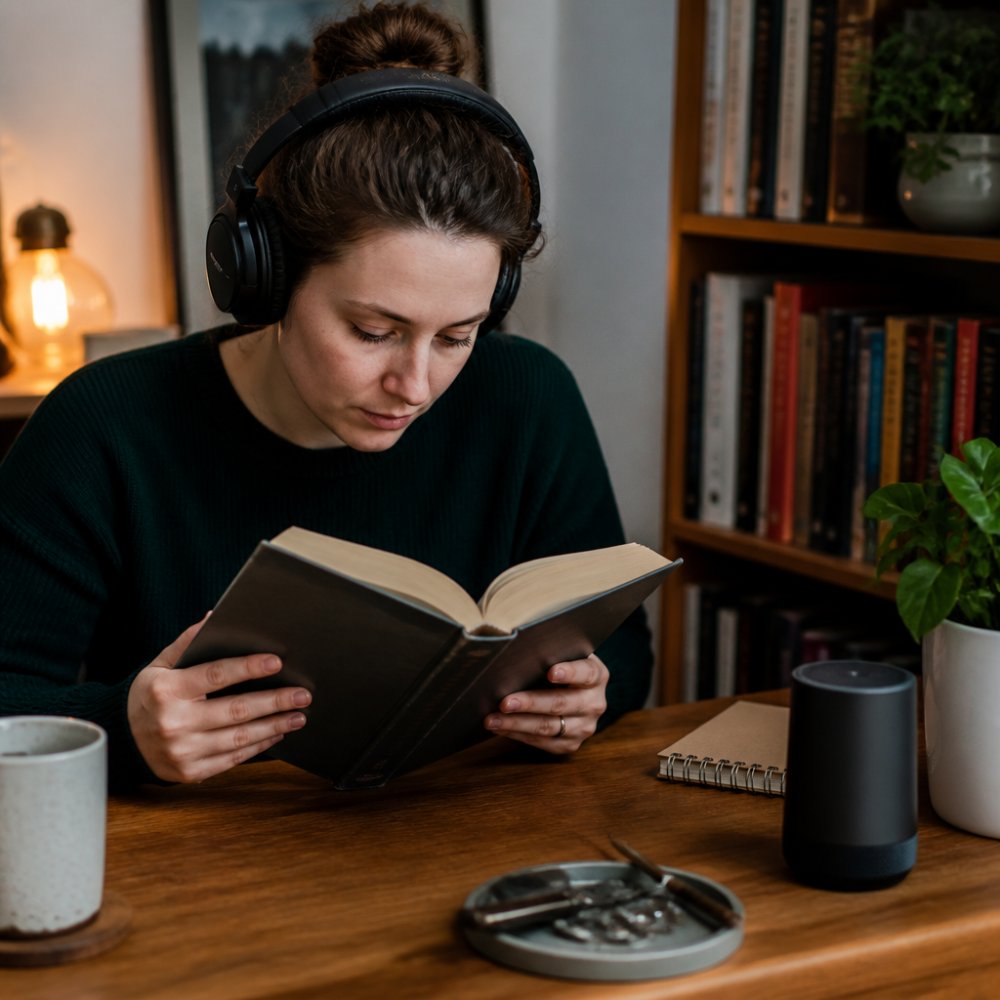
Here is how the two ways of reading compare:
|
Approach |
What It Adds |
Best For |
Drawback |
|---|---|---|---|
|
Book alone |
Full story, no setup |
Readers who want quiet focus |
No added atmosphere |
|
Book with soundtrack |
Emotional pacing, atmosphere |
Readers who want immersion |
Needs a device and headphones |
|
Soundtrack alone |
Standalone music |
Listening between chapters |
Loses the story context |
A few things worth knowing before you decide:
- The book is a historical fantasy set in 1930s Atlanta.
- Darius is nonverbal and written as neurodivergent, not diagnosed.
- The soundtrack is optional and works as standalone music.
- Free US shipping applies on the signed hardcover and soundtrack.
Frequently Asked Questions
Does listening to music while reading help with comprehension?
It depends on the music and the reader. Instrumental tracks at low volume tend to support focus and mood, which can help comprehension. Songs with lyrics compete for the same verbal processing you use to read, so they often reduce how much you retain. If you are reading something dense, try instrumental music first and see whether your recall improves.
What kind of music is best for reading?
Instrumental music works best for most readers: classical, ambient, lo-fi, or film scores without vocals. The steady rhythm and lack of lyrics keep your working memory free for the text. If you are reading a story with a strong emotional arc, a companion soundtrack written for that book can deepen the experience instead of distracting from it.
Can music help neurodivergent readers focus?
For many neurodivergent readers, yes. A consistent auditory environment can mask unpredictable background noise and give the brain a steady anchor, which supports focus and concentration. The key is control: choose the music yourself, keep the volume low, and treat it as part of a routine rather than a random playlist. What works for one reader may not work for another, so testing matters.
How do companion soundtracks change the reading experience?
A companion soundtrack follows the emotional shape of a story, so the music moves with the narrative instead of sitting behind it. The Color of Silence includes 22 original songs written in response to the book, and readers can play them on their own or alongside the chapters. For books about nonverbal autistic children, this pairing can make the emotional beats easier to feel and remember.